Learn what a growth mindset really means, why it matters for Mental Health, Wellness, and Personal Development, and how to build it step by step in daily life.
Why a Growth Mindset Matters for Mental Health, Wellness, and Personal Development
There are two ways people usually respond when life doesn’t go according to plan.
One person says,
“Maybe I’m just not good enough for this.”
The other says,
“Maybe I’m not there yet, but I can learn.”
That small difference in thinking may not look huge from the outside — but over time, it changes everything.
It changes how we handle failure.
How we deal with criticism.
How we respond to rejection.
How we grow after disappointment.
And most importantly, how we see ourselves when life gets difficult.
That way of thinking is called a growth mindset — and in today’s world, it is not just helpful, it is necessary.
Because in a world full of pressure, comparison, competition, and constant self-doubt, the way we think can either limit us or slowly free us.
And when we talk about inner growth, this is where Mental Health, Wellness, and Personal Development all come together.
What Is a Growth Mindset, Really?
In simple words, a growth mindset is the belief that your abilities, intelligence, skills, and emotional strength are not fixed forever.
They can improve.
Not magically.
Not overnight.
But through learning, patience, consistency, and effort.
This idea became widely known through the work of psychologist Carol Dweck, who explained the difference between two common patterns of thinking:
1. Fixed Mindset
This is the belief that:
- “I am either good at something or I’m not”
- “If I fail, it means I’m not capable”
- “Criticism means I’m lacking”
- “Challenges expose my weakness”
2. Growth Mindset
This is the belief that:
- “I can improve with practice”
- “Failure can teach me something”
- “Challenges help me grow”
- “I am not stuck as I am today”
And honestly, this second way of thinking can completely reshape your relationship with life.
Because when your mindset changes, your response to struggle changes too and that directly affects your Mental Health and overall Wellness.
Why This Matters More Than Ever Today
We live in a time where people are constantly trying to keep up.
Keep up with career growth.
Keep up with money.
Keep up with people online.
Keep up with success, goals, image, and expectations.
And somewhere in that race, a lot of people start believing that if they are not naturally “ahead,” then they are somehow behind forever.
That belief quietly damages both confidence and Mental Health.
It creates pressure.
It creates shame.
It creates fear of trying.
And that is why a growth mindset matters so much.
Because it reminds you of something powerful: You are allowed to be a work in progress.
That one belief can reduce a lot of internal pressure.
It helps you become less harsh with yourself.
Less afraid of failure.
Less emotionally stuck.
And that is not just mindset work.
That is also Wellness work.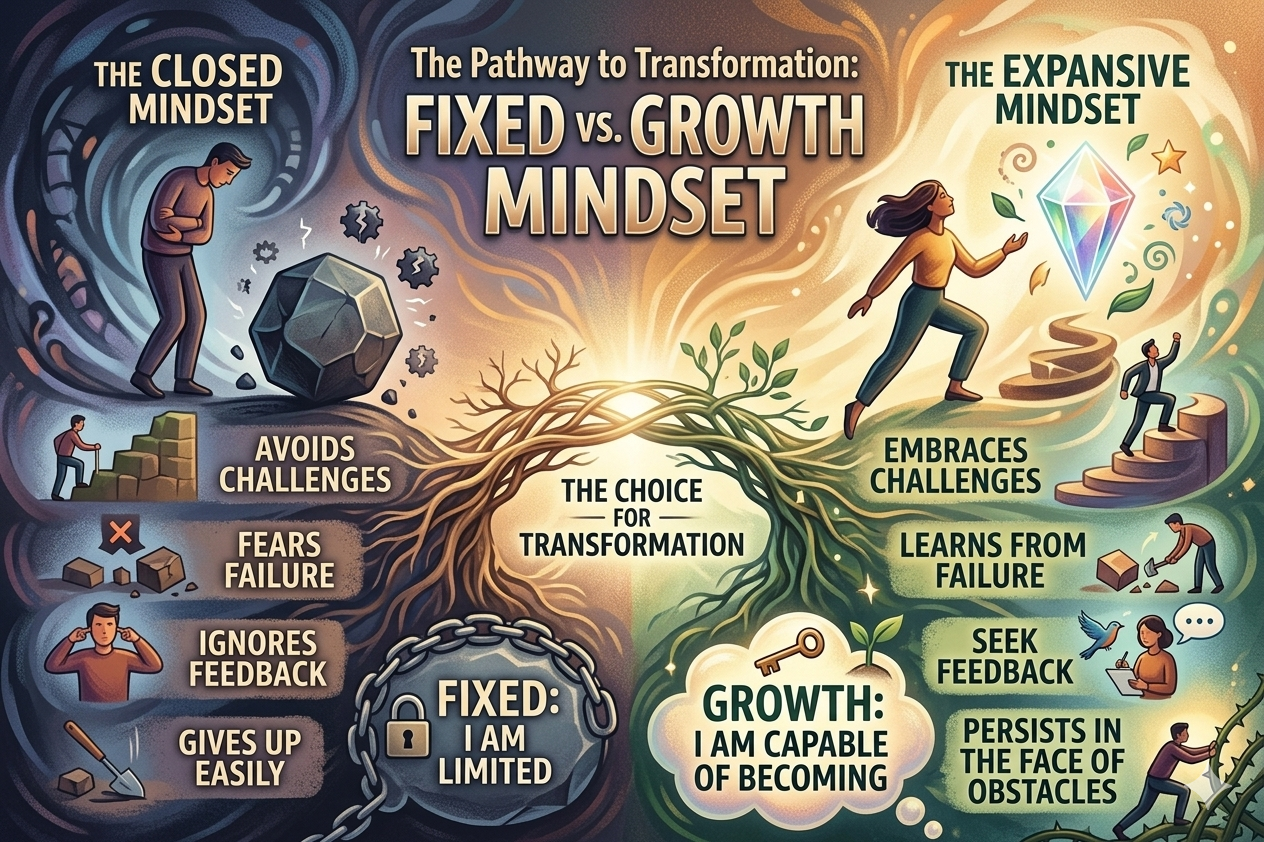
How Growth Mindset Supports Mental Health
A lot of people think Mental Health only improves through rest, therapy, or reducing stress.
And yes, those things matter deeply. But mindset matters too. Because the way you interpret your setbacks has a huge impact on how you feel emotionally.
Let’s say you make a mistake.
A fixed mindset might tell you:
- “You always mess things up”
- “You’re not capable”
- “Why even try again?”
A growth mindset, on the other hand, says:
- “This was difficult, but I can learn from it”
- “I need a different strategy”
- “This doesn’t define me”
That shift may sound simple, but emotionally, it is massive.
It protects your confidence.
It builds resilience.
It supports healthier self-talk.
And over time, that improves both Mental Health and emotional Wellness.
Because when your mind becomes less hostile toward you, life becomes easier to carry.
Personal Development Begins Where Excuses End
One of the biggest reasons people stay stuck is not lack of potential.
It is mindset.
Sometimes we quietly carry beliefs like:
- “I’m too late”
- “I’m not smart enough”
- “People like me don’t succeed”
- “I’ve already failed too many times”
These beliefs don’t always shout.
Sometimes they whisper.
And those whispers can shape your entire life.
This is why Personal Development is not only about learning new habits or becoming more productive.
It is also about identifying the beliefs that are quietly limiting your growth.
A growth mindset helps you question those beliefs.
It teaches you to stop seeing yourself as “finished” and start seeing yourself as someone still becoming.
That is where real Personal Development begins.
Not when life becomes easy.
But when your thinking becomes more flexible.
Can a Growth Mindset Actually Be Developed?
Yes — absolutely.
And that is the most encouraging part of all this.
A growth mindset is not something only a few lucky people are born with.
It is something you build.
Just like emotional strength.
Just like confidence.
Just like discipline.
The shift does not happen all at once.
It happens through awareness and repeated practice.
You begin by noticing how your fixed mindset shows up.
It might look like:
- fear of trying new things
- avoiding difficult tasks
- feeling threatened by criticism
- comparing yourself too much
- giving up too quickly after failure
Once you notice these patterns, you can begin changing them.
And that process supports both Mental Health and long-term Wellness in a very practical way.
Because every time you choose learning over self-defeat, you are rewiring the way you respond to life.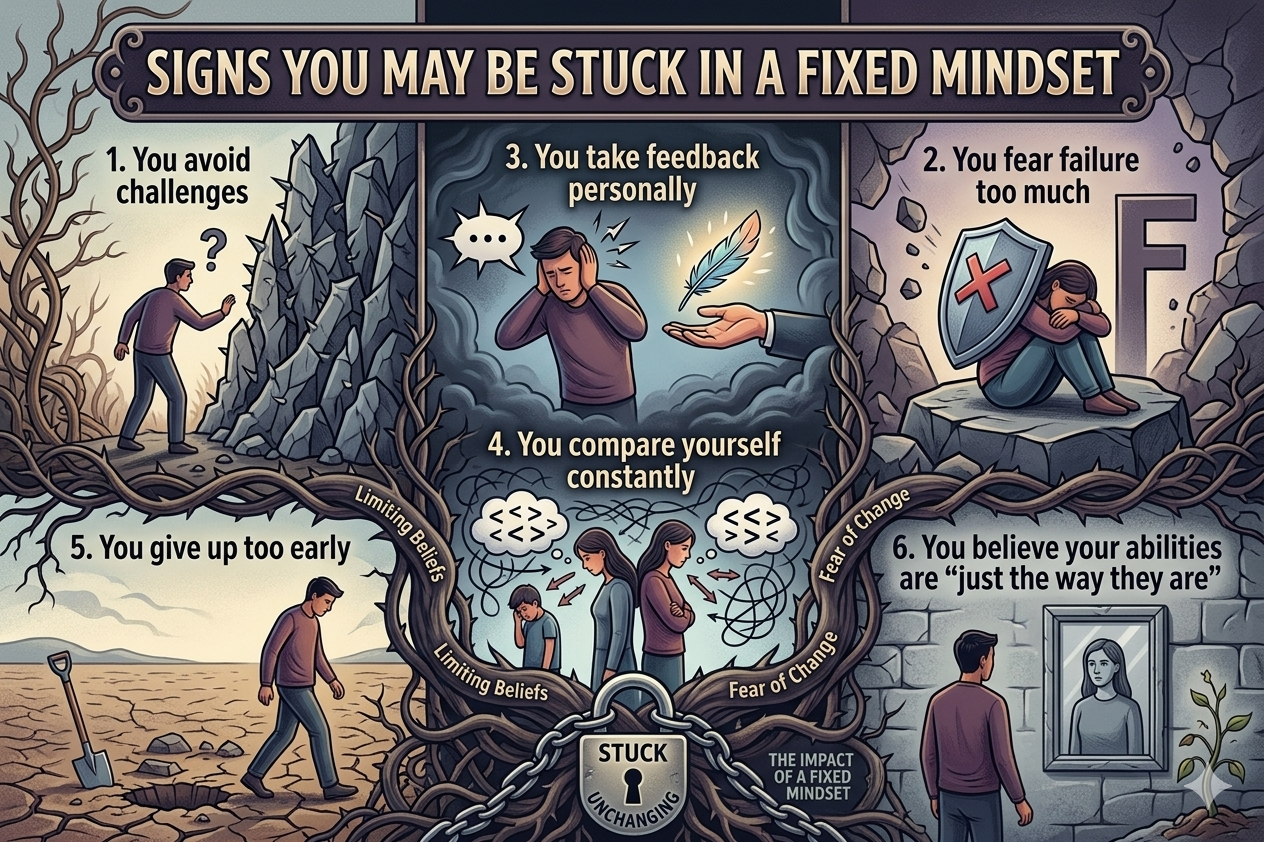
How to Build a Growth Mindset Step by Step
Here are some practical ways to develop a healthier and more growth-oriented mindset in everyday life:
1. Recognize your fixed mindset triggers
Notice when you start thinking:
“I can’t”
“I’m not enough”
“What if I fail?”
Awareness is the first step.
2. Start embracing challenges
Stop seeing difficulty as a sign to quit.
Sometimes challenge is proof that growth is happening.
3. Don’t fear failure
Failure is not always a dead end.
Sometimes, it is just feedback in disguise.
4. Respect effort — yours and others’
Not every win is visible. Effort matters more than people realize.
5. Keep learning
Read, reflect, listen, practice. Growth requires mental movement.
6. Build persistence
Progress is rarely instant. A growth mindset stays committed through discomfort.
7. Seek constructive feedback
Feedback is not an attack. It is often a shortcut to improvement.
8. Surround yourself with positive, growth-minded people
The people around you influence how you think about yourself.
9. Celebrate small wins
Every small improvement matters. Growth is built in tiny moments, not only big achievements.
This is where Personal Development becomes practical instead of theoretical.
Why This Mindset Matters in Real Life
A growth mindset is not just for students or professionals.
It helps in:
- business
- relationships
- communication
- confidence
- emotional healing
- self-belief
- long-term Wellness
It changes how you respond when:
- things don’t work out
- people doubt you
- life gets uncertain
- your plans fail
- your progress feels slow
Instead of collapsing emotionally every time something goes wrong, you begin asking:
“What can this teach me?”
That one question can completely change your life.
Because it shifts you from helplessness to growth.
And that shift is deeply connected to both Mental Health and Personal Development.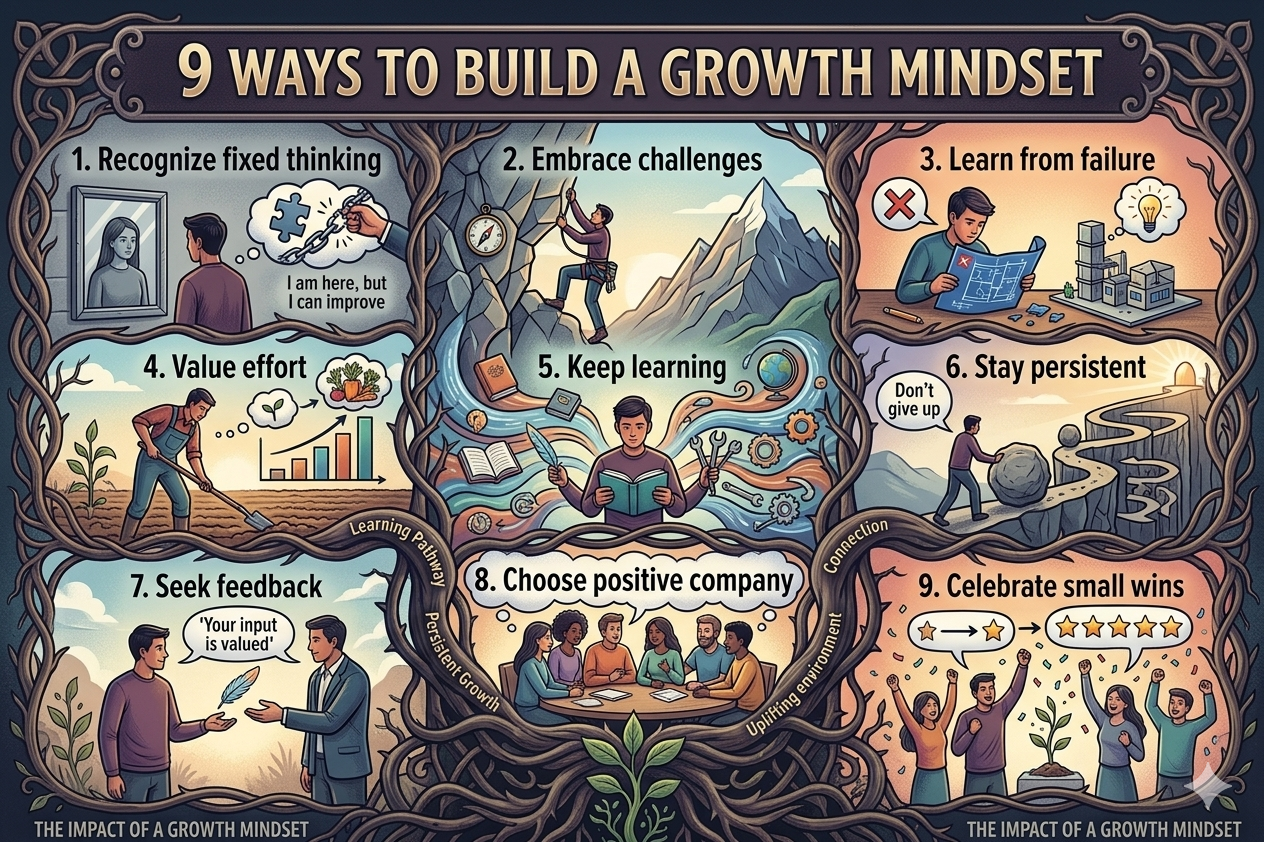
Final Thoughts
At the end of the day, life will always test you.
There will be failures.
Delays.
Disappointments.
Rejections.
Unexpected turns.
You cannot always control what happens.
But you can slowly learn to control how you respond.
And that is where a growth mindset becomes one of the most valuable tools you can build.
Because it does not promise an easy life.
It gives you something better:
a stronger way to live it.
And when that mindset is combined with better Mental Health, intentional Wellness, and honest Personal Development, the result is powerful.
You don’t just become more successful.
You become more stable.
More self-aware.
More resilient.
More capable of becoming the person you’re trying to grow into.
And honestly, that kind of growth matters the most.
Do you think you’re operating more from a fixed mindset or a growth mindset right now?
Take a moment to reflect — and if you’d like, share your thoughts in the comments.
Because sometimes, growth begins with one honest realisation.
JOIN THE
COMMUNITY
Subscribe and follow across all platforms